

RESILIENT LEADERSHIP SERIES · Article 1 of 5
Jason Michaels ◆ 9 min read ◆ Resilience · Leadership
“Most leadership articles are written from the safety of a corner office. This one was born in a hotel room in Al Kharj, Saudi Arabia — in the middle of the night, in the middle of a geopolitical crisis — while I was trying to convince myself to stop listening to every sound in the hallway and go to sleep.”
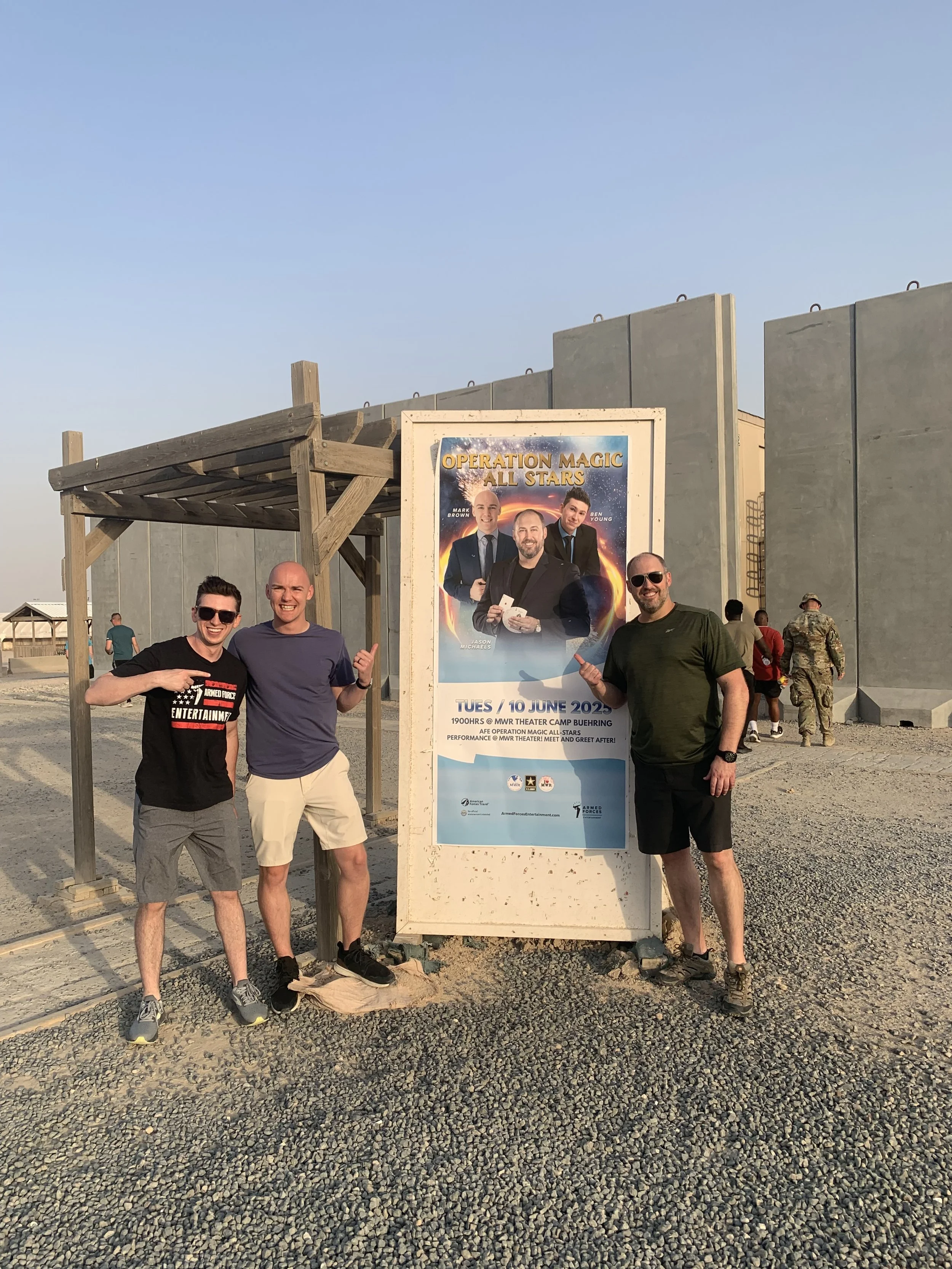
I lead a team of performers on overseas military tours. We travel to bases across the Middle East, Europe, and beyond — bringing magic, comedy, and a little piece of home to soldiers, sailors, airmen, and marines who are stationed far from their families. I have been doing this since 2015 under Armed Forces Entertainment, and in ten years of touring, every show has gone largely as planned.
June 2025 was different.
What happened on that tour — and how I led my team through it — taught me more about resilient leadership than any course, book, or boardroom ever has. Not because I did everything perfectly. Because I didn't. And because the job of a resilient leader isn't to be perfect. It's to keep moving.
When the Plan Disappears
We were one week into an eighteen-day tour when my team and I landed in Riyadh, Saudi Arabia on the evening of June 12th. We were tired from travel, focused on the shows ahead, and looking forward to getting settled on base. Before we even left the airport van, our point of contact told me that my Armed Forces Entertainment contact was trying to reach me urgently.
The military base we were supposed to sleep on that night was on lockdown.
In ten years, that had never happened. AFE told me to find a hotel — anywhere we wanted — and they would cover it. Simple enough, except that our base was several hours outside of Riyadh. I made a quick judgment call: stay close to the base rather than retreat to the city. The reasoning was practical. I expected we would perform the next day, and I didn't want our contacts making a four-hour round trip to retrieve us from a five-star Riyadh resort.
So we drove ninety minutes to Al Kharj — the nearest city to the base — and arrived at our hotel just after 11 pm.
The hotel's credit card reader was broken. They accepted cash, but not American dollars.
We found a second hotel a mile away. It appeared, from the street, to not be a hotel at all. We tried several locked doors before a man emerged from the shadows and gestured for us to follow him. He led us through what looked like an apartment hallway and into an unmarked room. That was the check-in desk. The room he showed us was clean, spacious, and exactly what we needed.
When we finally settled in, everything caught up with me at once.
01 Lesson One
Identify the Struggle
I want to be honest about what happened next, because I think leaders rarely admit to this part.
I sat in that hotel room and I spiraled.
I started thinking about all the ways things could go wrong — what I would do if my team was in danger, what it would mean to be stranded, whether I had made the right call staying close to the base instead of retreating to the city. One thought led to another, and before long I was jumping at every sound in the hallway.
I was exhausted, far from home, in an unfamiliar city, responsible for two other people, and the situation was genuinely uncertain. The anxiety made complete sense. But it wasn't helping anything.
“The first principle of resilient leadership is simply this: identify the struggle. Not suppress it. Not perform your way past it. Name it. I was scared. The situation was outside anything I had planned for. And acknowledging that — even just to myself in that dark hotel room — was the beginning of being able to lead through it.”
I finally calmed down and went to sleep.
The Morning the World Changed
I woke up to a screen full of notifications. Overnight, Israel had attacked Iran. By the time I reached my AFE contact that morning, the decision had already been made: the tour was being cut short. We were going home.
What followed — one morning, compounding fast
Booking three immediate flights out of Saudi Arabia on spotty internet access
Accidentally booking tickets a week in the future
Credit cards freezing mid-transaction
Losing laptop connectivity — falling back to a cell phone hotspot
Correcting the flights and securing a departure at 11:55 that night
Receiving a call from a base on full lockdown asking if I could "find a ride" — two hours from the airport
I told her I was not able to find my own transportation. She went to the base commander. He granted permission for them to take us. I genuinely hated putting her in that position. But my job at that moment was not to make things easier for everyone around me. It was to make the safest decision for my team. Those are not always the same thing.
02 Lesson Two
Talk About It
Here is something that does not get said enough about leadership: you are allowed to say when something is hard.
Not to your team in a way that creates panic. Not in a way that broadcasts uncertainty when people need steadiness. But in a real, human way that acknowledges the weight of what you are all carrying together.
When we finally made it to the Riyadh airport that afternoon — hours ahead of our flight, nowhere to go, nothing to do but wait — I sat with my teammates Mark Brown and Ben Young and we talked. About the situation. About the uncertainty. About the fact that none of us had expected our tour to end this way.
“Leadership is not a performance of invincibility. The performers I work with are professionals. They don’t need me to pretend that a geopolitical crisis is a minor inconvenience. They need me to be honest, steady, and present. There is a difference between those things.”
03 Lesson Three
Have Compassion for Yourself
I made mistakes that day. I booked the wrong flights. I stayed too long trying to solve things on a laptop that had lost its connection when a phone would have worked faster. I second-guessed the decision to stay near the base the night before, even though it was the right call.
Self-compassion is not the same as self-excuse. It is the ability to acknowledge that you are a human being operating under pressure, doing the best you can with imperfect information, and that making a mistake does not make you a failed leader. The leaders I have seen crack under pressure are rarely the ones facing the hardest situations. They are the ones who cannot tolerate their own fallibility.
I corrected the flights. I kept moving. And I extended myself the same grace I would have extended to anyone on my team who had made the same error under the same conditions.
Maintaining the Role When You Have Nothing Left
There is something I did not fully understand about leadership before I started leading teams in environments like this: the job does not pause when you are exhausted.
On a normal tour, I am the one who holds the energy of the group. When I am sharp and engaged, the team is relaxed. They perform better because they trust that whoever is in charge has things handled. The moment I visibly falter — the moment exhaustion or stress bleeds through — I can feel the group's anxiety rise.
On that tour, by the time we reached the airport, I had slept badly, made and corrected costly mistakes, navigated a lockdown, arranged emergency transportation, and spent hours managing a situation that had no playbook. I was running on very little. And I still had to be the leader.
“Leadership is not the role you fill when you are at your best. It is the role you fill especially when you are not.”
04 Lesson Four
Maintain Perspective
Somewhere around hour four of sitting in the Riyadh airport, watching flights get canceled on the departures board, I caught myself doing something useful: I thought about the people we had come to serve.
The soldiers on that base did not get to leave. They were locked down, in a region that had just become significantly more volatile, doing their jobs — the same jobs they had been doing before the news changed overnight. They were the ones I thought about when I was tempted to feel sorry for myself.
Perspective does not minimize difficulty. It contextualizes it. I was uncomfortable and stressed. I was also safe, heading home, and surrounded by people who had my back. Maintaining perspective is not toxic positivity. It is the deliberate act of placing your struggle inside a larger frame — one that allows you to acknowledge real hardship without being consumed by it.
05 Lesson Five
Have Gratitude
We boarded our flight on time. We made our connection at JFK. We came home.
My luggage did not. It took six weeks to find its way back to Nashville, having apparently gone on its own unscheduled adventure through parts unknown. At that point, it was easy to laugh about.
But in the airport, waiting for that flight, what I felt most clearly was gratitude. For Armed Forces Entertainment, who supported us every step of the way. For the base personnel who fought through bureaucracy to get us transported safely. For my teammates, who handled a genuinely difficult situation with professionalism and good humor. For the fact that we were going home to our families.
We had not completed the tour. We had not gotten to share magic with everyone we had planned to. That was a real loss — one I felt, and still feel.
But we came home safe. And that is everything.
What This Has to Do With Your Organization
You may not lead teams in combat-adjacent environments. You may not have spent a night in an unmarked hotel in Al Kharj or watched the departures board at Riyadh airport wondering if your flight was next to be canceled.
But you have had moments — or you will — when the plan disappears. When the situation changes faster than you can manage it. When you are exhausted and scared and responsible for other people and have no perfect options in front of you.
Resilient leadership is not a trait some people are born with. It is a practice. It is the repeated choice to identify the struggle rather than hide it, to talk about it with the people who need to hear it, to extend yourself enough compassion to keep functioning, to maintain perspective when the pressure is highest, and to hold onto gratitude even when the outcome is not what you planned.
I have led teams of magicians through military bases across the Middle East. I have served on the executive committee of the International Brotherhood of Magicians — a global organization spanning more than 80 countries — and fought for years against entrenched leadership to drag the institution into the modern era. I have stood in front of soldiers who were months from home and performed magic that made them laugh until they cried.
In every one of those contexts, the same five lessons have applied.
“The situation changes. The practice does not.”
Jason Michaels - Keynote Speaker · Magician · I.B.M. International President
Jason Michaels is a keynote speaker, sleight-of-hand magician, and author based in Nashville, Tennessee. He has performed for military audiences across the Middle East since 2015 under Armed Forces Entertainment and serves as International President of the International Brotherhood of Magicians. His resilience keynote helps organizations in healthcare, finance, and the military build cultures that last under pressure. To inquire about booking Jason, visit jasonmichaelsmagic.com.
Leadership Forged Under Pressure
Articles in this series:
Resilient Leadership: Lessons from a Crisis in Saudi Arabia
Resilient Teams: How I Prepare Performers for the Unexpected
Leading When the Stakes Are Real: What Performing for Soldiers Taught Me About Purpose