
RESILIENT LEADERSHIP SERIES · Article 4 of 5
Jason Michaels ◆ 2026 ◆ 10 min read ◆ Purpose · Service · Leadership
“Purpose is not something you find in a quiet moment of reflection. It is something you discover in the middle of doing hard work for people who genuinely need it — and realizing that you would not be anywhere else.”
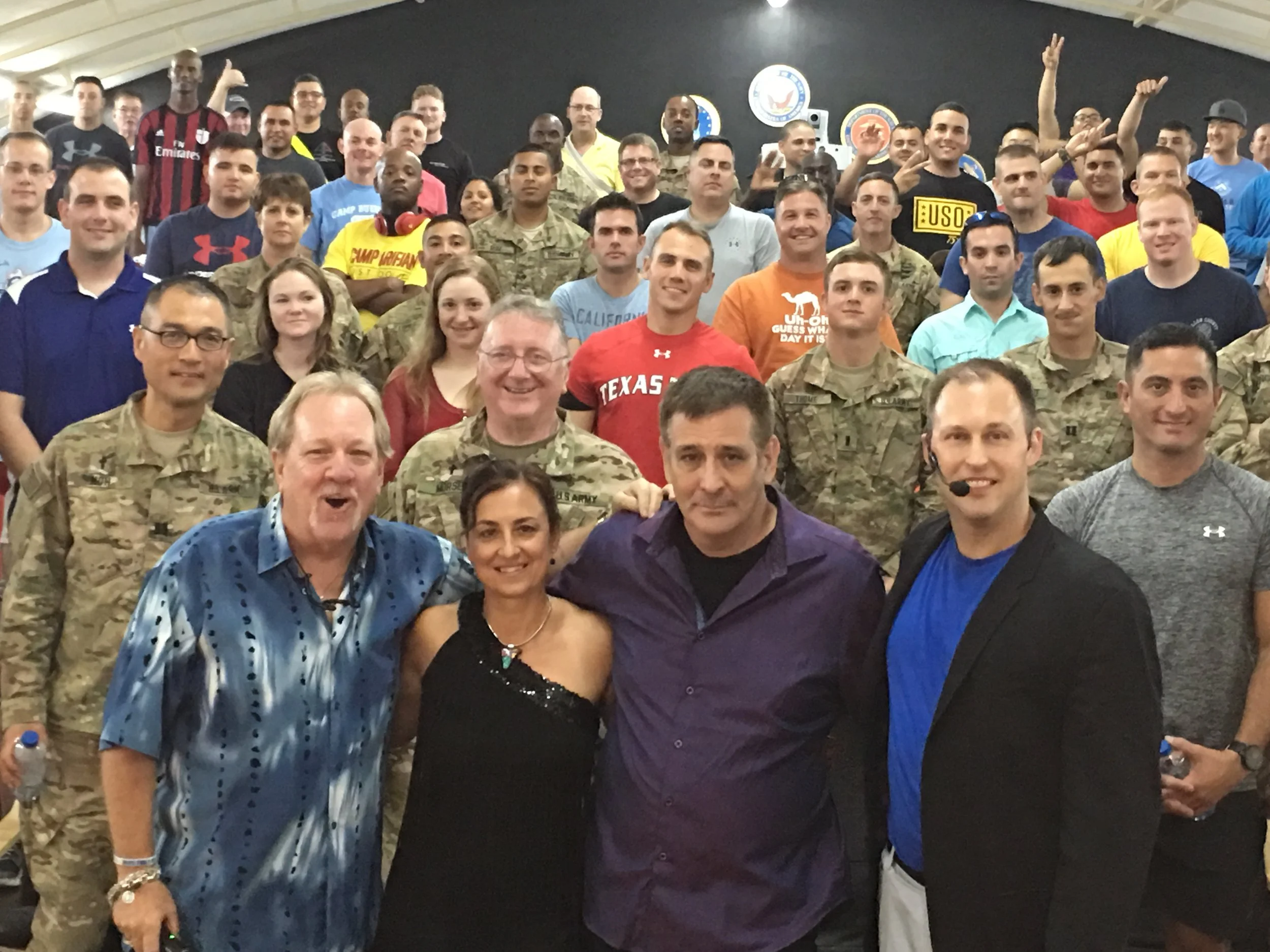
Not long ago, I was at a speaking engagement when a man approached me after my presentation. He introduced himself and told me that we had met before — years earlier, at a military base in the Middle East. He had been commanding a team of special operators. They had been outside the wire running missions. They had just come back from a particularly difficult and harrowing operation when he and several of his men decided, almost on impulse, to come see my Operation Magic All Stars show.
He told me that the laughter and magic they experienced that night was exactly what they needed. After what they had just been through, the show gave them something they could not have gotten anywhere else on that base — a few hours completely outside of what they were carrying. He thanked me, and then he said something I have thought about many times since: every time you show up on a base, you are doing important work. It really matters.
I did not know any of that was happening when I stepped onstage that night. I did not know what those men had just come back from. I did not know that what I was about to do would be exactly what a group of special operators needed after a mission I will never fully understand. I just did the show.
That is what purpose-driven leadership actually looks like from the inside. Not a mission statement. Not a framed value on a conference room wall. A person doing their work as well as they possibly can, for people who genuinely need it, without knowing in advance exactly what that work will mean to them.
The Audience That Changes Everything
I have performed magic for a long time, in a wide range of settings. Corporate events, private parties, luxury experiences, theaters, television. Every performance matters to me and I give everything I have to every audience.
But performing for troops deployed overseas is different in a way that is difficult to fully articulate. The difference is not in the quality of the performance — I do not perform harder for soldiers than I do for anyone else. The difference is in what the performance means, and what it costs me to give it.
When I perform for a corporate audience, those people chose to be there. They bought a ticket, or their company booked me, and they arrived with the reasonable expectation of being entertained. They come in wanting to enjoy themselves and they generally do.
When I perform for soldiers on an overseas base, the circumstances are entirely different. These men and women did not choose to be there. They are stationed far from their families in harsh conditions, often in countries where the language, the culture, and the level of personal safety are profoundly unfamiliar. Many of them have been there for months. Some will be there for much longer. They carry things that no corporate audience carries — the weight of the mission, the distance from home, the particular kind of exhaustion that comes from sustained high-stakes service.
When I walk into that room and start performing, I am not just entertaining them. I am giving them something that reaches past all of that — a moment of pure, uncomplicated joy that belongs only to them, not to the mission, not to the institution, not to anything they are required to do or be.
That is not a small thing. And I have never once treated it as one.
“Entertainment, in the right circumstances and in the right hands, is not a luxury. It is a necessity.”
What Purpose Actually Sounds Like
I have learned to read an audience — after years of performing, you develop an instinct for the room. You can feel when something lands, when the energy shifts, when a person who came in guarded begins to open up. With military audiences, the signal I listen for above everything else is laughter.
Not polite laughter. Not the laughter of people who are trying to be good audience members. The loud, unguarded, release-of-something laughter that happens when a person stops thinking about everything else and is just, for a moment, completely present in the room with you. That sound — when a room full of soldiers gives it to you — is unlike anything else I have experienced in this work.
It tells me three things at once, and each one matters:
01 Presence
By showing up on their base, we demonstrate that people back home have not forgotten them. That alone changes something in the room before a single trick is performed.
02 Morale
A great show lifts the room immediately. The laughter is the proof. Joy that is felt collectively — in a shared space, between people who have been through hard things together — compounds in ways that individual joy cannot.
03 Resilience
Combine presence and morale and you give people a better capacity to deal with the isolation and difficulty of what comes next. You do not solve those things. But you help people carry them with more grace.
I have had soldiers pull me aside after shows to confide that they had been having a genuinely difficult time — that the weeks leading up to our arrival had been harder than they wanted to admit, and that our show had been something they had been looking forward to for weeks. I have had people tell me that they genuinely appreciated the fact that my team and I were willing to leave our families and put ourselves in harm's way to come to them. That what we were doing was not just entertainment — it was a statement that they were worth showing up for.
I do not know how to receive that gracefully every time. But I know that it is the truest confirmation I have ever received that the work I am doing is the work I am supposed to be doing.
Running on Empty — and Performing Anyway
I want to tell you something that is true about this work and that I think matters for every leader reading this: I have walked onstage for military audiences while running completely on empty.
Jet lag is not a minor inconvenience on these tours. Travel across multiple time zones, in and out of countries with significant logistical complexity, living on military bases with limited amenities — the cumulative physical cost is real. There have been shows where I was sick. Shows where I was so tired I could not fully account for how I had gotten there. Shows where the honest version of how I felt had absolutely no business being onstage.
I went onstage anyway. Every single time. Not out of obligation but out of conviction — because the moment I have an audience of military personnel in front of me, something clarifies. The exhaustion does not disappear. But it becomes irrelevant. What becomes relevant is the room, the people in it, and what I owe them.
This is what a genuine sense of purpose does for a leader. It does not protect you from the hard moments. It gives you a reason to move through them anyway — one that is larger than your own comfort, your own fatigue, your own preference for how things are going.
THE MEET AND GREET — AFTER EVERY SHOW
After every show we do a meet and greet — open to anyone who wants to come by, take a photograph, say hello. Sometimes these run long. Sometimes I am standing there after two hours of performing, after days of travel, shaking hands and taking pictures with the last few people in line.
And sometimes, in that line, there is a person who introduces themselves quietly and has a look in their eye that I have learned to recognize. It is the look of someone who is genuinely, deeply thankful — not for the performance specifically, but for the fact that we came at all. They say thank you and they mean it in a way that goes well past the polite social version of those words.
Every time I see that look, whatever was left of my exhaustion becomes irrelevant. That exchange — thirty seconds, a handshake, a photograph — is worth every hour of travel that preceded it.
What Service Does to a Leader
These soldiers chose to serve. That choice — to subordinate personal comfort and personal safety to something larger than themselves — is the defining fact of their professional lives. When I bring my team to their bases, I am, in my own much smaller way, making the same choice. I am saying: your mission matters enough that I am willing to leave my family, travel to difficult places, and do this work under conditions that are far removed from the comfortable venues where most of my career takes place.
That orientation — leading with a heart of service rather than a need for recognition — has changed how I lead in every other context.
I know, when I walk into a hotel ballroom to deliver a keynote, that I can succeed in that room. Part of that confidence comes from the repetition of having done it many times. But a quieter, more durable part of it comes from having performed magic in a cafeteria corner on a military base in the desert, for an audience that had just come back from something I will never fully understand, and watching them laugh until they forgot, just for a moment, where they were.
If you can do that — if you can reach people in conditions like those — you can reach people anywhere. And the knowledge that you have done hard things, that you have not shied away from the difficult version of your work, builds a kind of confidence that no amount of preparation in comfortable surroundings can replicate.
The hardest version of your work is not a burden. It is the proof that you are capable of more than you think. Every leader who has done the hard thing — and seen it through — carries that knowledge forward into every room they enter after it.
01 First Lesson
Purpose Lives in Service, Not Recognition
The clearest thing that performing for military audiences has taught me about purpose is this: it does not come from being seen. It comes from serving.
There are no headlines for showing up on a military base in the middle of the desert. There is no red carpet at the entrance to the cafeteria. The audience is not there because of your reputation — many of them will not know your name before you walk onstage, and some will not remember it after. What they will remember is how they felt during those two hours. Whether you gave them something real.
The leaders I most admire — in any field — are the ones who have found something worth doing that does not depend on being recognized for doing it. That independence from recognition is not passivity. It is the deepest form of commitment. You do the work because the work matters, not because someone is watching.
02 Second Lesson
Hard Challenges Reveal Who You Actually Are
I have never shied away from hard work. I say that not as a boast but as a statement of personal philosophy — because I believe that the willingness to do hard things, and to see them through, is one of the most important things a person can cultivate about themselves.
Every difficult tour, every challenging show, every moment I performed when I had nothing left — each one added something to what I know about myself. Not just that I could do it. But that the doing of it was worth something. That the people on the other side of my effort were changed by it in ways that I would not have been able to reach from a comfortable distance.
The leaders who develop the deepest confidence are not the ones who have had the easiest paths. They are the ones who have faced the hard version of their work, moved through it, and emerged knowing — not just believing, but knowing — that they are capable of more than they thought.
03 Third Lesson
Seeing Your Impact Transforms You
The special operators commander did not have to find me at that speaking engagement years later. He did not have to tell me what that night had meant to his team. He chose to, because the experience had stayed with him long enough that when he saw me again he wanted me to know.
That moment did something to me that I am still processing. It confirmed something I had believed but never had confirmed quite so directly: that the work I have been doing on these tours has a reach I cannot see from the stage. That the people sitting in those audiences carry something from those shows with them long after I have packed up and headed to the next base.
When you can see — really see — the impact of your work on the people you are there to serve, it does not just feel good. It changes your understanding of what you are doing and why. It recalibrates your sense of what matters. And that recalibration follows you into every room you enter afterward, making you a more grounded, more purposeful, and ultimately more effective leader.
“When you see what your effort means to the people you serve, it does not just motivate you. It transforms you.”
The Questions Worth Sitting With
I am not suggesting that every leader needs to perform magic on a military base to find their purpose. I am suggesting that the questions those experiences have forced me to answer are questions worth asking in any leadership context.
Questions for Purpose-Driven Leaders
→ Is there a version of your work that would feel worth doing even if no one was watching — even if the recognition, the title, and the compensation were stripped away? If yes, you have found something real. If no, it is worth understanding why.
→ When did you last do the hard version of your work — the version that cost you something, that pushed you past what was comfortable? What did that experience add to what you know about yourself?
→ Who are the people your leadership is ultimately in service of — not your organization, not your shareholders, but the actual human beings whose lives your work touches? When did you last see, up close, what that impact looks like?
→ Is there a harder, more demanding version of your work that you have been avoiding — one that would ask more of you but reach people you are not currently reaching? What would it take to do that version?
Purpose-driven leadership is not a feeling you maintain by thinking about it. It is a practice you develop by doing — by repeatedly choosing the harder path, the more demanding audience, the work that costs you something real. And by staying present enough, when you are in the room with the people you are there to serve, to see what that work actually means to them.
The special operators commander did not need to find me to tell me that story. He had no obligation to close that loop. But he did — because something that happened in a show I performed years ago, for an audience I barely remember the details of, had stayed with him long enough that he wanted me to know.
I do not know what equivalent of that is waiting for you somewhere in the future of your own leadership. But I know that it is only findable by people who showed up and did the work — especially when they had nothing left — for people who genuinely needed it.
That is where purpose lives.
Jason Michaels
Keynote Speaker · Magician · I.B.M. International President
Jason Michaels is a keynote speaker, sleight-of-hand magician, and author based in Nashville, Tennessee. He has performed for military audiences across the Middle East since 2015 under Armed Forces Entertainment and serves as International President of the International Brotherhood of Magicians. His keynote programs on resilience, purpose, and leadership draw on more than a decade of performing and leading in some of the world's most demanding environments. To inquire about booking Jason, visit jasonmichaelsmagic.com.
Leadership Forged Under Pressure
Articles in this series
Resilient Leadership: 5 Lessons from a Crisis in Saudi Arabia
Resilient Teams: What Leading Performers in Combat Zones Taught Me
Leading Change Against Resistance: How I Dragged a Century-Old Institution Into the Modern Era
Leading When the Stakes Are Real: What Performing for Soldiers Taught Me About Purpose