
The Craft · Playing Card Culture · Sleight of Hand
A deck of cards costs five dollars. It carries more human stories than almost any object in existence. And in the hands of someone who has spent twenty-five years learning what it can do, it produces something that no amount of money can otherwise buy.
Jason Michaels | 8 min read | The Craft | Playing Card Culture | Sleight of Hand
“Before any performance begins, the deck is already in the room. Sitting on the table, or in a jacket pocket, or in a hand extended toward the first spectator. Nobody looks at it twice. Nobody needs to. Everyone knows what it is.”
That is the point. That is everything.
A deck of playing cards is the most universally recognized object in human culture that nobody ever thinks about. Not because it is uninteresting — it is extraordinarily interesting, in ways that most people have never had occasion to discover. But because it is so familiar, so present in so many contexts across so many stages of a life, that familiarity has become invisibility. The deck sits on the table and the eye moves past it to the wine, the centerpiece, the face of the person across from you.
And then something happens to it that should not be possible. And the deck — the five-dollar, drugstore-available, completely ordinary deck — becomes the most interesting object in the room.
What everyone in the room already carries.
Here is what I know about every person in every room where I have ever performed: they already have a story attached to a deck of cards. Not maybe. Not most of them. Every single one.
The stories are different. The object is the same.
This is what makes the deck of cards unique among performance objects and unique among objects generally. It is not merely familiar — many things are familiar. It is personally storied. Every person who has ever held a deck has held it in a specific context, at a specific moment, with specific people, and that context became part of how they understand what the object is. The deck does not arrive in a room as a neutral prop. It arrives carrying every story every person in the room has ever attached to it.
The grandmother and Solitaire
For some people in the room, a deck of cards is the first game they ever learned — taught by a grandparent at a kitchen table, the rules explained with patient repetition, the suits named one by one. That memory is in the deck. It arrives with it.
The gambler's last hand
For others, a deck represents something heavier — the specific weight of cards turned face-up on a poker table when everything depends on them. The moment before the river card. The calculation that precedes the bet. The deck as the instrument of hope and consequence simultaneously.
The fortune teller's spread
For some, the deck carries the specific atmosphere of a tarot reading — the cards laid in a pattern, each one turned with deliberate care, the reader interpreting something in the arrangement that seems to know more than it should. The deck as an instrument of the unknowable.
The three-card monte on the corner
For others, the deck — or the three cards on a cardboard box — is associated with the street hustle, the con, the sleight that separates a tourist from their money before they understand what has happened. The deck as instrument of the underworld, the quick hands, the misdirection that costs someone something real.
The long evening with friends
For most people in most rooms, the deck is simply the center of an evening — a game of Rummy or Bridge or Euchre or Spades, the specific pleasure of a familiar ritual with familiar people, the deck as the structure around which conversation and competition and companionship organize themselves.
None of these stories is the same. Every one of them involves the same object. And when that object does something impossible in someone’s hands, the impossibility does not occur in a vacuum. It occurs in the context of everything that person has ever understood the deck to be. Which makes it more astonishing, not less — because it is not wonder at something unfamiliar. It is wonder at something they have held a thousand times and thought they understood completely.
The history hiding in plain sight.
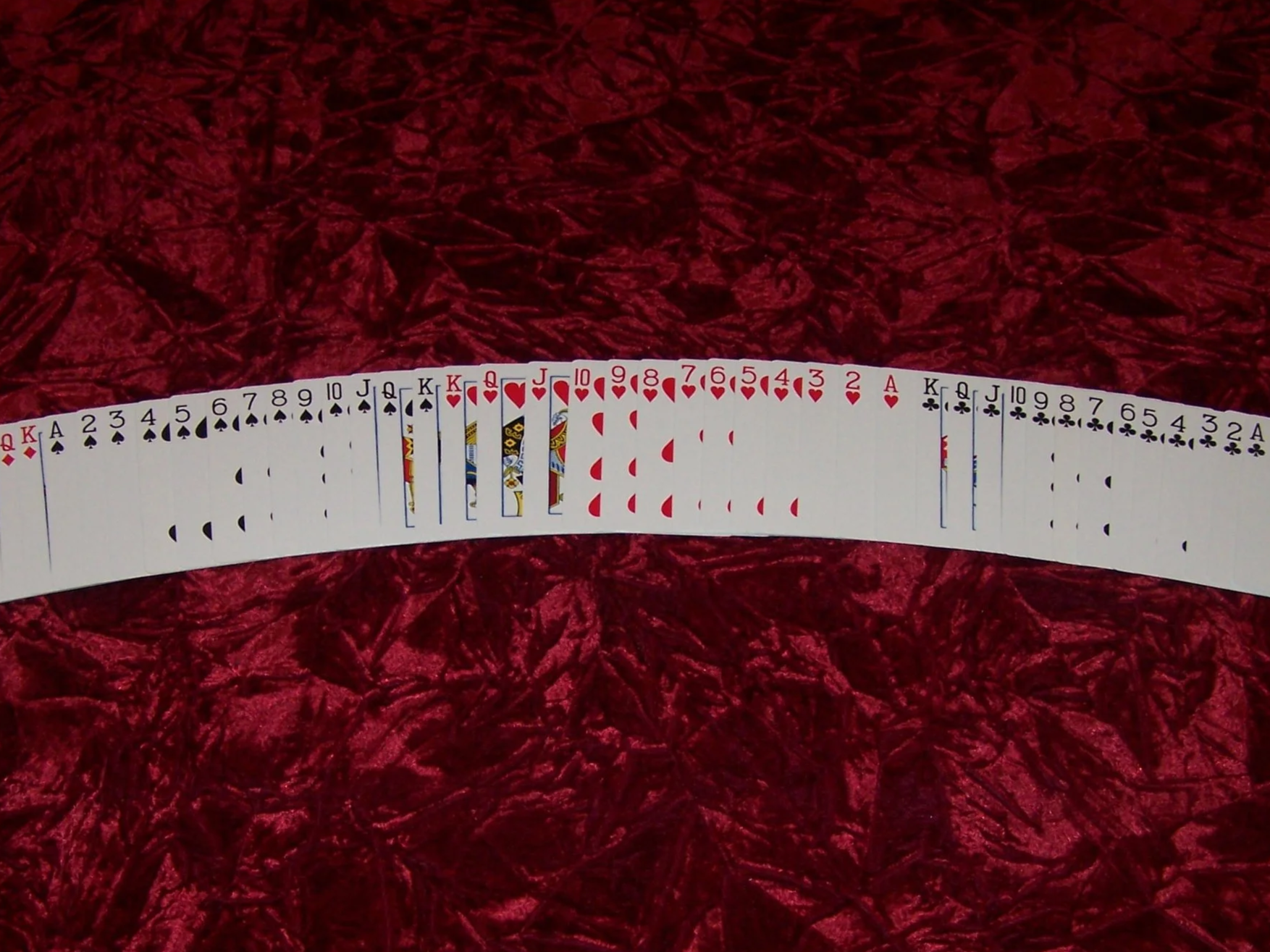
Most people have held a deck of cards hundreds of times without knowing what they were actually holding. The history encoded in those fifty-two cards is richer and stranger and more deeply embedded in Western culture than almost anything else that fits in a jacket pocket.
The four suits — hearts, diamonds, clubs, spades — are a French innovation from the fifteenth century, adapted from earlier German suits of hearts, bells, acorns, and leaves, which were themselves derived from Arabic and Persian playing cards that entered Europe through the trade routes of the fourteenth century. The deck arrived in Europe carrying the traces of every culture it had passed through on the way.
The fifty-two cards correspond to the fifty-two weeks of the year. The four suits correspond to the four seasons. The thirteen cards in each suit correspond to the thirteen weeks in each quarter. The values of the cards, if you count the jack as eleven, the queen as twelve, the king as thirteen, and add a joker, sum to three hundred and sixty-five — the days of the year. The deck is a calendar, encoded in a game.
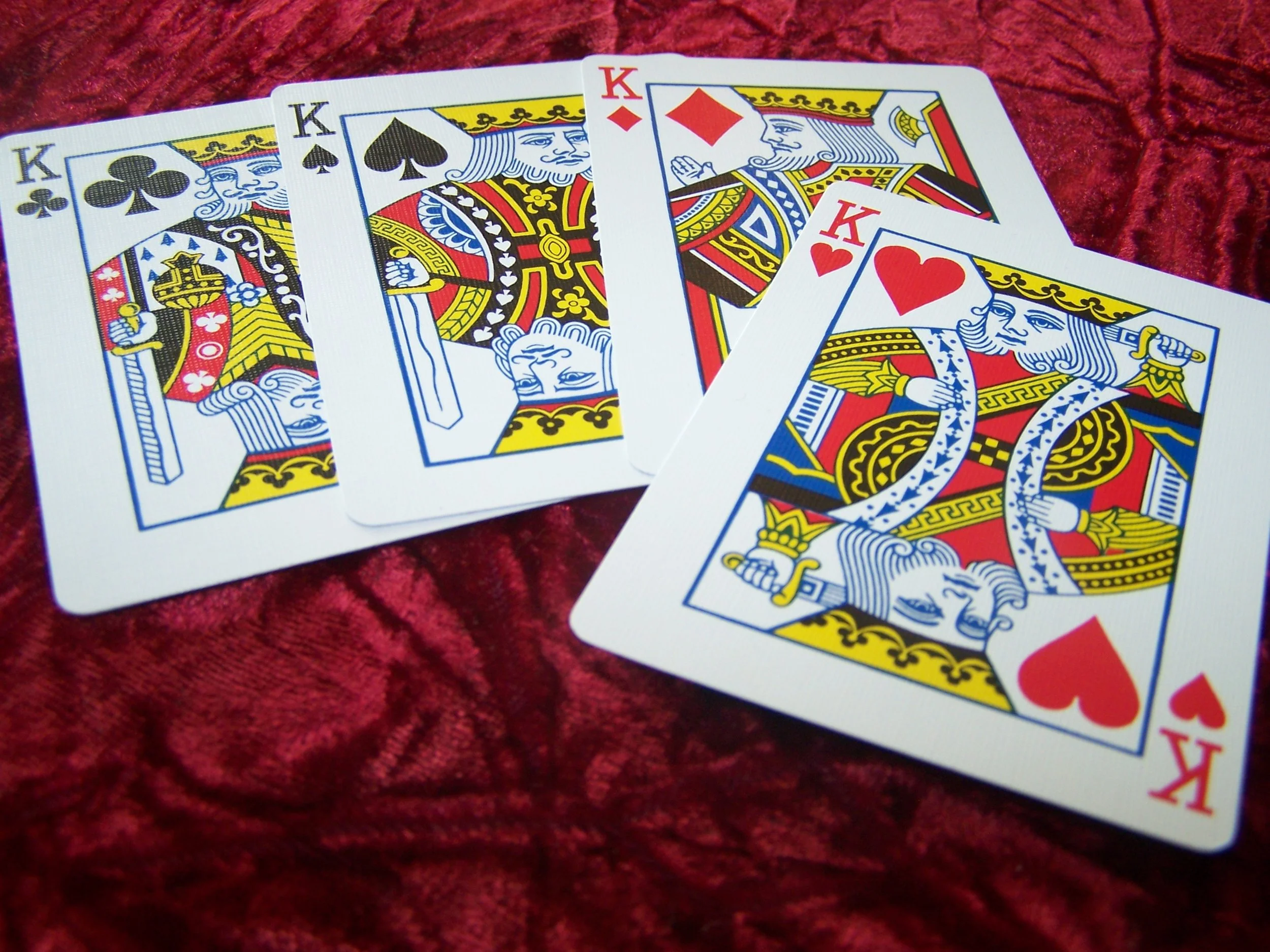
The court cards — the kings specifically — were long associated with historical rulers. The king of spades with David. The king of clubs with Alexander the Great. The king of hearts with Charlemagne. The king of diamonds with Julius Caesar. Whether these associations are historically reliable matters less than the fact that they existed — that at some point, the cards were understood to carry the faces of the people who had shaped history.
“The phrase ‘not playing with a full deck’ entered everyday English so completely that most people who use it have no idea it is playing card history. The language carries the deck even when the deck is not in the room. It has been present in human culture for six hundred years, across every continent, in every class and context, from the gambling dens of medieval Europe to the drawing rooms of the Enlightenment to the kitchen table where someone’s grandmother taught them Solitaire. The deck is not an object that belongs to magic. It belongs to everyone. That is why it works.”
Why the humble object is the hardest proof of mastery.
There is a chef named Michel Guérard who became famous in the 1970s for building his finest dishes around the humblest possible ingredients. Cabbage. Lentils. Root vegetables. The things that had always fed the poor, elevated by technique so refined that the ingredient itself became almost irrelevant. What mattered was not what it was. What mattered was what someone who genuinely understood it could make it become.
The Michelin stars followed.
The principle is older than cooking and broader than any single discipline. The greatest jazz musicians worked with twelve notes — the same twelve notes available to every beginner who has ever touched a piano. The finest writers worked with ordinary words, the same words used in grocery lists and text messages. Hemingway built his reputation on short sentences. The constraint is not the limitation. It is the condition that makes mastery visible.
If you work with precious materials — if the ingredient itself is rare or the medium is inherently spectacular — some portion of the result belongs to the material rather than the maker. The rarity does part of the work. But if you work with the ordinary, with the common, with the thing that everyone has held and nobody has thought about twice, then everything extraordinary in the result belongs entirely to you. The humble object is the purest test of mastery. There is nowhere to hide.
A deck of cards costs less than five dollars. It is available at any drugstore, gas station, or airport newsstand in the world. There is nothing exclusive about it. Nothing rare. Nothing that signals, in any way, that it belongs in the same category as the wine in the glasses or the watches on the wrists of the people sitting around it. It is the most ordinary object in the room. And it is precisely that ordinariness that makes what happens to it in the right hands so complete. The five-dollar object is what proves the twenty-five-year investment. Nothing expensive could do that.
What the familiarity makes possible.
When a sleight-of-hand artist picks up a deck of cards in a room full of sophisticated people, something specific happens before any technique has been applied. Every person in the room runs a rapid, unconscious assessment of what they are looking at. They have held a deck of cards. They know what one can and cannot do. They form, without realizing they are forming it, a set of expectations about what the next few minutes will contain.
Those expectations are the foundation on which the impossible is built.
If the object were unfamiliar — if the performer produced something none of the spectators had ever encountered — the reaction to what followed would be curiosity rather than astonishment. They would not know what the object was capable of, so anything it did would simply be a new datum about an unknown thing. There is no impossibility available to an object without context.
The deck has context. The deck has six hundred years of context, and a personal history in every hand it has ever been held by, and a set of deeply held convictions in every person in the room about exactly what it can and cannot do. Those convictions are precise. A deck of cards does not make things appear from thin air. A deck of cards does not know what you are thinking. A deck of cards does not change in your hand after you have signed it and are holding it yourself.
Everyone in the room knows this. Which is why, when it happens, the response is not curiosity. It is something closer to the feeling that the rules of the world have briefly been suspended in the specific room where they happen to be standing.
The familiarity is not incidental to the experience. The familiarity is what makes the experience possible. Without it, there is no astonishment — only novelty. With it, the impossible occurs not in some abstract space but in the context of everything the spectator has always known about this specific object. That context is what transforms a surprising trick into a genuinely irreversible experience.
Why it belongs at the finest events in the world.
The buyers who commission world-class close-up magic for private dinners, corporate VIP events, luxury gatherings, and intimate celebrations are not buying a deck of cards. They are not even, in the most precise sense, buying a performance. They are buying the specific experience that occurs when the most ordinary object in the room does something that defeats the understanding of the most sophisticated people in it.
That experience is available nowhere else. It cannot be produced by a more expensive prop or a more spectacular production. It requires the specific combination of the humble object, the twenty-five-year investment, and the room full of people who knew exactly what a deck of cards was capable of — and have just discovered that they were wrong.
The grandmother taught Solitaire. The gambler turned over the river card. The fortune teller spread the reading. The con artist worked the corner. All of those stories are in the deck. And when the card changes in someone’s hand in a private dining room in Las Vegas or a wine cellar in Portugal or a mountain lounge in Colorado, the impossible does not happen to a stranger. It happens to the object they have known their entire life.
That is what makes it stay.
CONTINUE READING
The Mastery Gap: What Twenty-Five Years of Daily Practice Actually Produces
The second article in the series — on what separates a competent card handler from a world-class sleight-of-hand artist, and why the difference is visible in a room within thirty seconds.
ABOUT JASON MICHAELS
Jason Michaels is a sleight-of-hand artist, keynote speaker, and author based in Nashville, Tennessee. He is President Elect of the International Brotherhood of Magicians and a member of Fechter’s Finger Flicking Frolic (4F), an invitation-only gathering of the world’s most respected close-up performers. He has appeared on Penn & Teller: Fool Us and has been featured in The New York Times. Over twenty-five years, he has performed in more than 55 countries for private clients, Fortune 500 corporations, military leadership, and luxury brand events.
He is the author of You Can Do the Impossible, Too! — a memoir about growing up with Tourette Syndrome and building a career that requires absolute precision.
To inquire about close-up magic for private events and luxury gatherings, visit jasonmichaelsmagic.com or reach out at jm@jasonmichaelsmagic.com.
BOOK YOUR EVENT
Bring the most ordinary object in the room to life.
Close-up magic for private dinners, corporate VIP events, and luxury gatherings. Limited dates available each season. Tell Jason about your event and he’ll respond personally within 24-48 hours.
PREFER EMAIL?
EVENT INQUIRY
A few details help Jason respond meaningfully. This is the beginning of a conversation, not a booking form.